Generative AI struck from clear skies. Practically overnight, it created a new frontier of computing where everyone had an opinion, no one had experience, and people freaked out because we were all about to lose our jobs. It would have been a great moment to show we learned from the errors of the past, a chance to welcome a world-changing technology rationally.
Instead, we got hype, zealotry, and panic. All the classics, at once. Powered by today’s weaponization of discourse to maximize noise at all costs, it was not a constructive moment. So I stepped out of the circus, and built things with this new technology.
One of those things was BoltPage.
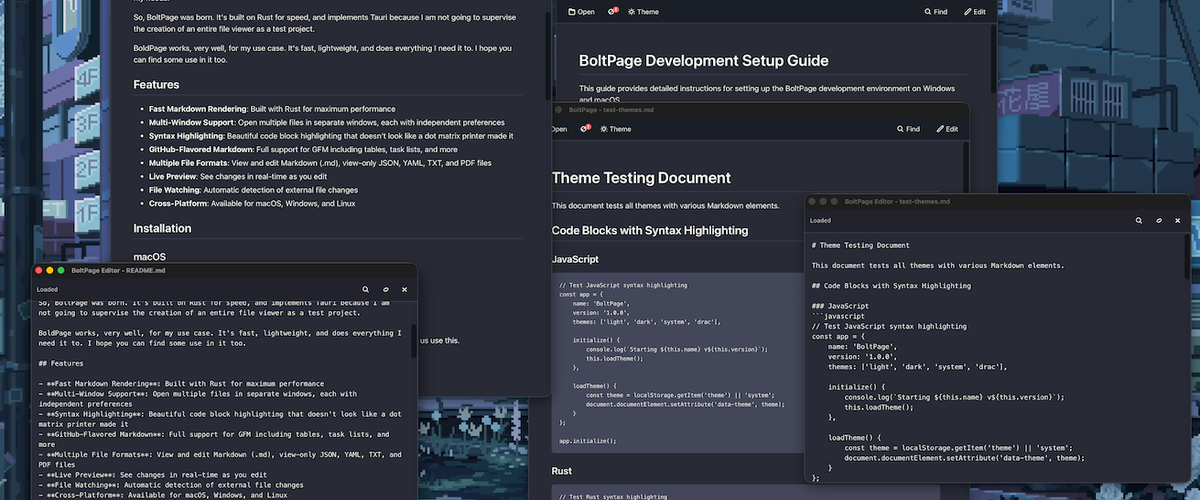
A real app, not a thought experiment, nor a billion-dollar SaaS, BoltPage is a simple desktop application built to consume and edit Markdown files the way no other app anywhere did: quickly, without using too much RAM, and prettily. It’s built on Rust for speed, uses Tauri for its UI and web views, runs on Windows, macOS, and Linux, and is available for everyone to use or dig through its code right here: https://github.com/Silverfell/BoltPage
I vibe-coded it aggressively. AI scaffolded most of the project, wrote and rewrote chunks of logic, and even created the all the Github pipelines to test and built the application automatically.
Working on BoltPage left me with three clear conclusions.
If you cannot ship software, AI will not save you
The first version of BoltPage was built in 95 minutes. It launched, opened Markdown files, and looked like it was done.
It also was complete garbage. It had memory leaks, confused responsibilities between Tauri and the Rust backbone, had no idea how to work with MacOS Open file events, and could not run outside of my machine.
The project was precisely what I had asked for. It compiled, it ran, it did what I described. It had no sense or understanding of the architecture I needed and assumed AI would provide.
For example, I intended to use Tauri for display purposes. The agents tried to perform file actions through Tauri as well. That’s like using a browser to read local files. It’s not just wrong for this project, it’s simply impossible. Unless told to desist repeatedly and clearly, the AI kept insisting on this pathway unless I spelled it out.
The cross-platform stuff was even worse. When I started working on BoltPage, I had no idea how macOS hands files to desktop apps, and just how fundamentally different from Windows that is. AI was unable to plumb such depths independently and kept assuming the last edge case it fixed was the new norm. I had to study up on all that stuff so I could clearly direct it through the maze of differences and peculiarities.
There is a dark truth at the core of software development: writing code is at most 25% of the work. The rest is integration and deployment, and you can’t skip it or you don’t have a product.
Magical prompts that let you create a working version of your dream SaaS do not exist. Anyone trying to sell you on them is a snake oil salesman.
AI coding agents are kind of awesome
Not all AI contact surfaces are equal. Web chatbots are tuned to sound confident and reassuring, often at the expense of reality and truth. They can be useful for small code snippets or explanations, but they are a terrible way to do real development work.
AI coding agents are different. They run on your machine, see your files, and can use tools. They deploy the same intelligence as the best frontier-class models, but tuned to get stuff done, rather than to impress you.
On BoltPage, learning that distinction was a revelation. Coding agents performed all scaffolding, provided all the repetitive glue work, managed all the pipelines and configurations like bosses, and dominated all refactoring tasks.
They still needed to be aimed and briefed properly. They could still not be trusted to remember architectural standards and decisions. all their code had to be reviewed, tested, and compared to specs.
This was nothing new. Working with humans is very much the same. After my experiences in the last year, I can state absolutely and without sarcasm that AI coding agents are my favourite junior programmer colleagues.
They are not senior engineers, they cannot independently deliver working solutions. They do not hold architecture and its consequences in their heads. They absolutely do not replace the sparring you can perform with other seniors. None of that is real. However, properly managed, they can be an enormous force multiplier in any development team.
AI is a tool
To date, and for a good few decades to come, AI remains just a tool.
An amazing, transformative tool. It will automate things that have been requiring human grind for decades. It will give laypeople access to sophisticated technologies with nothing more than a simple English sentence. Generative AI, in its current form and upcoming developments is here to stay and that’s a good thing.
It will be difficult to withstand the endless hype around AI. Every voice out there is trying to sell expertise that didn’t exist two years ago, trying to establish their point of view as the definitive perspective. It’s too early for any of that.
No matter what the propaganda circus is shouting, AI is not more than a tool. It cannot create, only generate. Its programming abilities can never exceed precise, framed, SANE requests. AI is a companion, not an autopilot with understanding and conscience.
If you write software for a living, you will have to find a way to deal with the inevitability of AI. Stop doomscrolling and do the only thing that makes sense: give it a whirl. Don’t try to prove your prejudices, actually test the thing.
It is much worse than you imagine. Hilariously bad in many aspects. It will also surprise you and change your mind about its use cases. Even if it’s just all for the worse, which I suspect won’t be the case, you will at least have your own, informed opinion.
If you are outside software development and hope you can be a developer without understanding the birds and the bees of database access and denial of service attacks, you’re out of luck.
However, if you want to learn, and make your first steps in the world of programming, I can think of no better companion to have by your side than the big, drooling, derpy, terminally enthusiastic puppy that AI can be.
Building BoltPage with AI convinced me of its usefulness, of just how transformative it can be. It’s not the end of programming, or writing, or art. It is however a tool so powerful that it will force you to reconsider how you work and what your true value is, or you’ll be left behind.